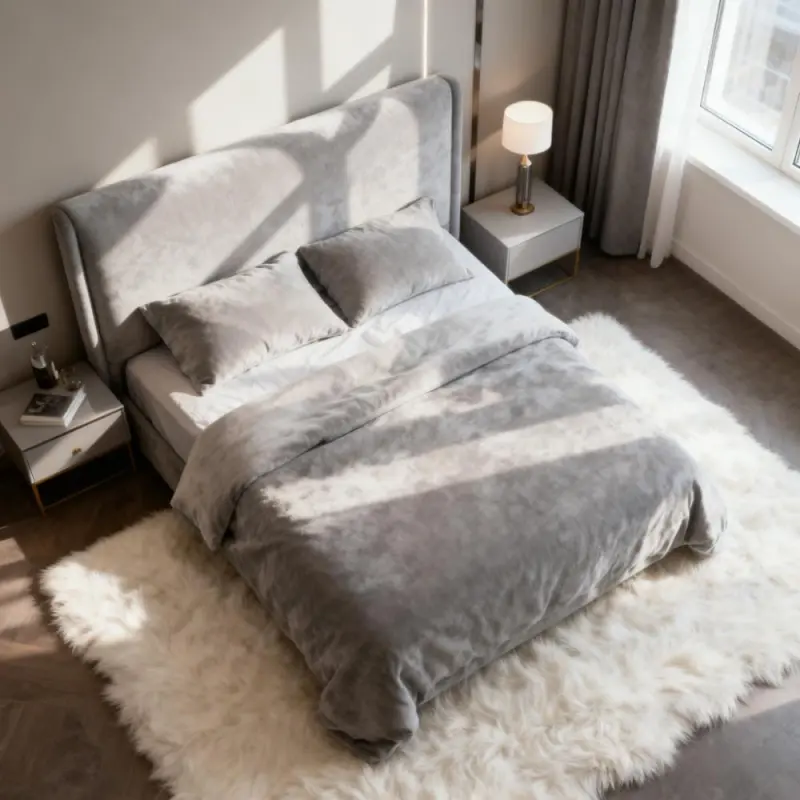
In the current market, many consumers are misled by the appearance and price of storage beds. They often focus on the external design and the seemingly attractive price, while overlooking the most crucial factor - the stability of the bed. This has led to many people purchasing beds that do not meet their long - term usage needs, such as beds that make loud noises when opened and closed or beds that cannot bear heavy loads.
The structure of hydraulic rods plays a vital role in the stability of hydraulic lifting beds. There are mainly two types of hydraulic rod structures in the market: single - rod and double - rod.
The single - rod hydraulic structure is relatively simple and cost - effective. However, its stability is limited. In a 100,000 - cycle test, it was found that after about 50,000 cycles, the single - rod hydraulic bed began to show signs of instability, such as uneven lifting and a slight decrease in the locking force.
On the contrary, the double - rod hydraulic structure provides better support and balance. In the same 100,000 - cycle test, the double - rod hydraulic bed maintained excellent stability throughout the test. The following table shows a comparison between the two structures:
| Structure Type | Stability after 50,000 Cycles | Stability after 100,000 Cycles |
|---|---|---|
| Single - Rod | Slight instability | Significant instability |
| Double - Rod | Excellent stability | Excellent stability |
The load - bearing capacity is a crucial indicator of the quality of a hydraulic lifting bed. Through 100,000 - cycle tests, it was found that the double - rod hydraulic bed can maintain a stable load - bearing capacity of up to 300 kg, while the single - rod hydraulic bed's load - bearing capacity may decrease to about 200 kg after 50,000 cycles.
The double - rod hydraulic bed is usually equipped with a silent slow - closing device. The principle is to use a special hydraulic damping system to reduce the impact force when the bed is opened and closed, thus effectively reducing noise. In a quiet environment, the noise level of the double - rod hydraulic bed is less than 30 decibels, while the single - rod hydraulic bed may produce noise up to 50 decibels.
The double - rod hydraulic bed has an anti - accidental fall mechanism. This mechanism ensures that the bed will not accidentally fall when in use, providing higher safety. In contrast, the locking mechanism of the single - rod hydraulic bed may be less reliable after long - term use.
In small - sized apartments, the double - rod hydraulic bed's stability and large load - bearing capacity make it a great choice for storing various items. For families with babies, the low - noise feature ensures that the baby's sleep will not be disturbed. In pet - owning families, the anti - accidental fall mechanism provides a safer environment for both pets and family members.
To ensure the quality and safety of hydraulic lifting beds, it is recommended to pay attention to certification standards such as EN719 and ASTM F2057. Products that meet these standards have undergone strict testing and can provide higher quality assurance.
Whether you are a home decor user, a decoration company, or a home furnishing retailer, understanding the differences between single - rod and double - rod hydraulic structures can help you make a more professional purchasing decision. If you want to know more about the detailed test reports, you can contact our customer service to obtain the PDF version.
 253
|
253
|
 EN71 standard compliance
sofa product safety testing
furniture export certification
EU child safety regulations
ISO9001 for home goods
465
|
ASTM F400-09 child furniture safety
EN71 vs ASTM compliance
modular sofa export standards
international furniture certification
child product safety testing
129
|
high density foam sofa
sofa durability
memory foam vs down fill
tech fabric sofa
modular sofa assembly
100
|
modular sofa
small living room layout
U-shaped sofa arrangement
L-shaped sofa optimization
ergonomic sofa design
419
|
furniture environmental certification
FSC wood certification
CARB formaldehyde standards
abrasion-resistant tech fabric
solid wood furniture durability
EN71 standard compliance
sofa product safety testing
furniture export certification
EU child safety regulations
ISO9001 for home goods
465
|
ASTM F400-09 child furniture safety
EN71 vs ASTM compliance
modular sofa export standards
international furniture certification
child product safety testing
129
|
high density foam sofa
sofa durability
memory foam vs down fill
tech fabric sofa
modular sofa assembly
100
|
modular sofa
small living room layout
U-shaped sofa arrangement
L-shaped sofa optimization
ergonomic sofa design
419
|
furniture environmental certification
FSC wood certification
CARB formaldehyde standards
abrasion-resistant tech fabric
solid wood furniture durability