If you’re shopping for a hydraulic lift bed—especially if you're targeting international markets like Europe, North America, or the UAE—you might be overwhelmed by options. Don’t fall into the trap of choosing based on price alone. The real difference between a budget product and an export-grade one lies in three technical parameters that affect durability, safety, and daily comfort.
Think of your bed’s hydraulic system like a car’s shock absorber—it needs to handle repeated stress without failure. A reliable manufacturer will test each rod for at least 100,000 cycles under full load (typically 150–200 kg). That means it can be raised and lowered over 250 times per week for more than 2 years straight without wear.
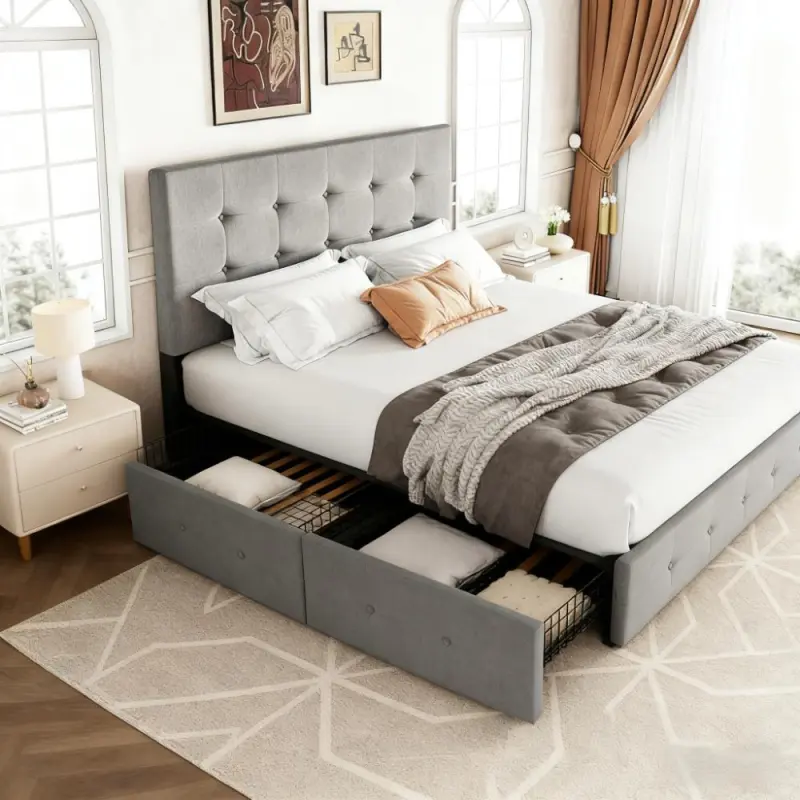
Why does this matter? Imagine a family with twins who need to access storage drawers every night. If the hydraulic rods fail after just 3 months, it’s not just inconvenient—it’s a safety risk. Ask suppliers for test reports showing cycle counts. If they hesitate, walk away.
Most people don’t realize how much noise from a lifting mechanism affects sleep quality—especially in shared spaces or small apartments. A good design uses a hydraulic damping valve that slows the descent, creating a soft "thud" instead of a loud bang.
In fact, studies show that nighttime disturbances caused by furniture movement increase cortisol levels in adults—even if they don’t fully wake up. For parents of newborns, this silent closure feature is often the deciding factor between a peaceful night and constant frustration.
This is where many cheap beds cut corners. A proper locking system ensures the bed stays firmly in place during use—not just when fully extended or retracted. Look for models with dual-lock mechanisms: one mechanical (like a steel pin) and one hydraulic (pressure-based).
For example, our export-certified models have passed UL/EN 1727 testing, which simulates accidental weight shifts—such as a child climbing on the bed frame. These tests ensure no sudden drops occur even under irregular loads.
Quick Tip: When comparing two similar beds, ask: “What happens if I sit on the edge while it’s half-lifted?” If the response isn’t immediate and confident, proceed with caution.
You’re not just buying a bed—you’re investing in smarter space management, better rest, and long-term value. Whether you're designing for urban families in Dubai, minimalist couples in Berlin, or multi-generational homes in Toronto, these specs should guide your decision.
Want to see detailed test reports or explore custom configurations for your market? Download Our Export-Quality Testing Report (PDF)
 379
|
379
|
 silent slides
storage bed procurement
drawer noise control
ball bearing rail technology
EN71 safety standards
411
|
hydraulic lift storage bed
small bedroom storage solutions
sealed storage design
adjustable soft headboard
space optimization furniture
99
|
memory foam sofa fill
down blend cushion
modular sofa design
sofa comfort test
high density foam
129
|
high density foam sofa
sofa durability
memory foam vs down fill
tech fabric sofa
modular sofa assembly
224
|
Storage bed design techniques
Small - sized bedroom storage
Hydraulic lifting bed
Silent closing system
Soft - packed headboard
silent slides
storage bed procurement
drawer noise control
ball bearing rail technology
EN71 safety standards
411
|
hydraulic lift storage bed
small bedroom storage solutions
sealed storage design
adjustable soft headboard
space optimization furniture
99
|
memory foam sofa fill
down blend cushion
modular sofa design
sofa comfort test
high density foam
129
|
high density foam sofa
sofa durability
memory foam vs down fill
tech fabric sofa
modular sofa assembly
224
|
Storage bed design techniques
Small - sized bedroom storage
Hydraulic lifting bed
Silent closing system
Soft - packed headboard