

In the realm of compact urban living, maximizing both space and comfort has become a design imperative. Modular sofas offer a versatile solution, especially for small living rooms where efficient use of space and smooth traffic flow are paramount. This tutorial delves into the practical applications of U-shaped and L-shaped modular sofa combinations, underscored by ergonomic principles and backed by user data, enabling designers, homeowners, and renters to make informed layout choices.
Modular sofas are composed of individual sections that can be rearranged or customized to fit various spatial constraints. Unlike traditional fixed sofas, their adaptability is critical in small apartments where each square foot counts. The core advantage lies in the ability to tailor shape, seating capacity, and function — such as integrating storage or extending seating — to user needs.
| Configuration | Space Utilization | Traffic Flow Efficiency | Ideal Room Size |
|---|---|---|---|
| U-Shaped Sofa | High | Moderate | 20-30 m² (215-320 sq.ft) |
| L-Shaped Sofa | Moderate | High | 12-20 m² (130-215 sq.ft) |
U-Shaped Arrangements create an intimate seating environment by enveloping users on three sides, promoting social interaction. Their slight drawback in small spaces is a tendency to restrict walkways if not sized properly, making them best suited for rooms above 20 square meters. The key to success is balancing seat depth with available clearance—a recommended seat depth of 60–70 cm supports cloud-like comfort without overwhelming the space.
L-Shaped Sofas are inherently space-saving, aligning along two adjacent walls. This layout optimizes traffic flow by opening pathways through the remainder of the room. For spaces under 20 square meters, L-shaped modular sofas offer flexibility that can be enhanced with detachable components, such as a moveable ottoman or chaise that can double as additional seating or storage.
A 2023 survey of 500 small-apartment dwellers revealed that 68% preferred L-shaped sofas for ease of movement, while 32% favored U-shaped setups primarily for social settings. This underscores the value of matching sofa configuration to lifestyle and space constraints.
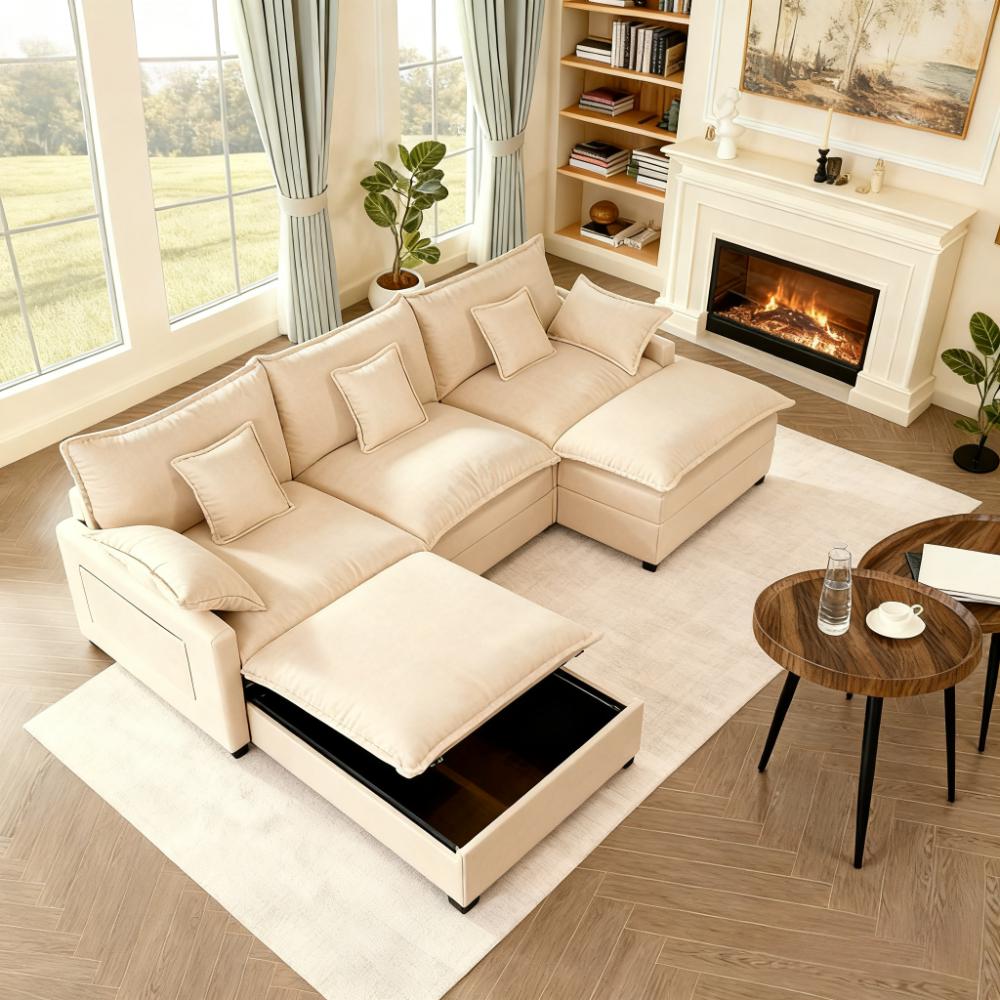
Beyond spatial layout, ergonomic features define user satisfaction. The recommended seat depth of 60–70 cm harmonizes with average human dimensions, promoting proper posture and relaxed seating for prolonged periods. This dimension, paired with filling density ranging between 35–45 kg/m³ of high-resilience foam combined with down-alternative fiber, delivers durability and softness—key to preventing premature sagging.
User feedback consistently highlights that such materials maintain shape across years of daily use, enhancing the perception of quality. Also, modular sofas with removable and washable covers improve hygiene and longevity—an increasingly important purchase factor.
The incorporation of detachable footstools or ottomans transforms a traditional sofa into a multi-use asset. These components can function as extra seating, storage boxes, or even occasional tables. Particularly for small dwellings, this versatility enhances space efficiency and user satisfaction.
Consider the case of a newlywed couple in a 16-square-meter apartment utilizing a modular sofa with a removable ottoman. The footstool doubles as a storage unit for linens and trips seamlessly from under the sofa to a stand-alone lounge seat when hosting guests. This adaptability reduced their need for additional furniture by up to 40%, an important cost and space saver.
This method aids buyers in predicting satisfaction levels and optimizing their investment, reducing return rates and improving user experience.
Interior designers and users often fall into the trap of prioritizing aesthetics over functionality—choosing overly large sofas or non-modular designs that compromise traffic flow or leave dead zones. Another common error is neglecting the potential of detachable elements, which can limit a room’s flexibility as needs evolve.
Proper planning should marry visual appeal with spatial intelligence, ensuring that modular designs do more than fill space—they empower users with adaptability.


