In today's competitive furniture market, silent slide rails emerge as a vital component in delivering superior comfort and user experience, especially for storage beds. This article delves into the intricate mechanics of silent slide rail technology, highlighting the structural nuances of ball bearing guides, advanced damping systems, and noise-reducing track designs. Grounded in internationally recognized safety and performance standards such as EN71 and ASTM F400, the discussion equips consumers and industry professionals with crucial insights for selecting high-quality silent slide rails that significantly uplift everyday usage.
Ball bearing slides serve as the foundational technology in silent slide rails, providing low-friction, durable support for drawers in storage beds. Typically composed of hardened steel bearings housed within corrosion-resistant channels, these rails achieve sliding smoothness with minimal noise generation. Industry data indicates that high-end ball bearing systems can reduce friction coefficients by up to 40% compared to conventional steel-on-steel mechanisms, directly contributing to quieter drawer movement.
The integration of precision-engineered ball bearings ensures a tolerance range within 0.01mm, dramatically lowering rattling and misalignment, which are primary noise sources during operation. Additionally, anti-corrosive coatings and sealed bearing units extend lifespan, maintaining silent performance over 50,000 cycles or more.
Effective noise suppression hinges on sophisticated damping mechanisms embedded within the slides. These systems utilize hydraulic or silicone-based dampers that absorb kinetic energy during drawer closure, halving impact noise levels on average. Such damping buffers prevent abrupt stops that could otherwise cause harsh sounds and wear.
The typical damping system achieves time-delayed closure speeds below 0.3 m/s, offering a controlled and whisper-quiet drawer operation highly valued in bedroom furniture markets globally. This gradual deceleration not only enhances user comfort but also prolongs rail integrity.
Beyond mechanical components, track design plays a pivotal role in minimizing sound transmission. Manufacturers employ ultra-low friction polymers and strategically structured rails that dissipate vibration efficiently. Profiles with closed-track geometries and integrated noise-absorbing strips reduce ambient noise by an estimated 15-25%.
Moreover, leveraging innovative materials such as thermoplastic elastomers (TPE) within channels cushions metallic contact points, significantly controlling micro-noise events otherwise undetectable but cumulatively disturbing.

Compliance with EN71 safety standards ensures materials used are non-toxic and safe for household environments, critical for furniture used in children’s rooms. Meanwhile, ASTM F400 establishes performance criteria, including cycle durability, static and dynamic load capacities, and noise thresholds.
Products meeting these standards demonstrate robust build quality, guaranteeing consistent silent operation through millions of drawer actuations with noise levels under 35 dB—a threshold linked to comfortable home environments as per ergonomic research.
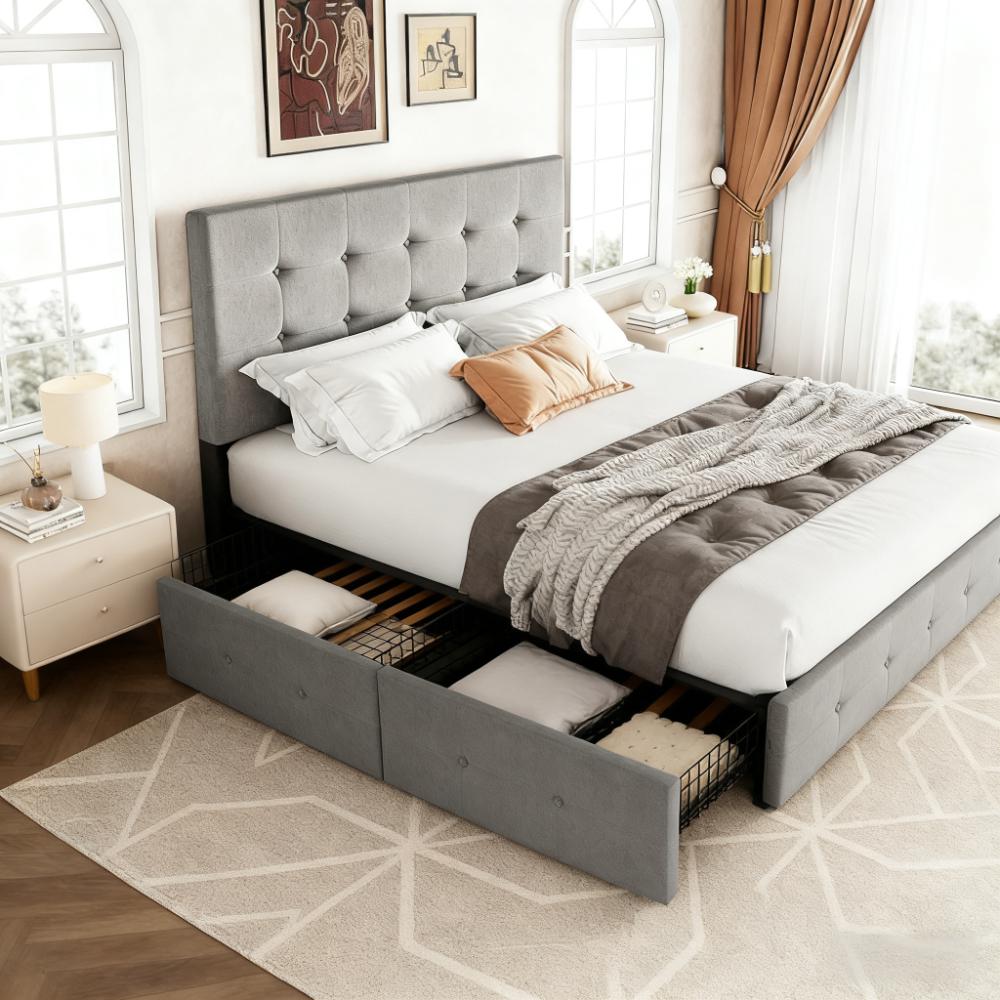
For end-users and retail buyers, assessing slide rail noise can be as straightforward as the “light push test”. Applying a gentle, even force on the drawer surface should result in smooth, near-silent extension and retraction. Audible clicking, rattling, or scraping may indicate inferior or worn components.
Optimal silent slide rails maintain noise levels below 30 dB under these tests, which can be measured using smartphone sound meter apps. Consistent silence during such tactile inspections reflects well-executed design and assembly quality.

Silent rails significantly elevate the perceived quality of storage beds. Consumers report greater satisfaction, citing reduced stress and increased comfort, especially in shared or quiet environments like bedrooms. Data from furniture market surveys indicate a 25% higher repurchase intent when silent mechanisms are incorporated.
For manufacturers and sellers, investing in premium silent slide rail systems can differentiate products in saturated markets, justify premium pricing, and minimize after-sales complaints related to noise or malfunction.
 35
|
35
|
 Storage bed design techniques
Small bedroom storage solutions
Practical functions of hydraulic lift beds
Modern minimalist furniture recommendations
Export - grade eco - friendly beds
47
|
silent storage bed rails
gentle push drawer test
drawer rail noise detection
storage bed buying guide
ball bearing rail technology
466
|
ASTM F400-09 child furniture safety
EN71 vs ASTM compliance
modular sofa export standards
international furniture certification
child product safety testing
410
|
silent drawer slides
storage bed hardware
quiet drawer mechanism
ball bearing drawer glide
noise-reducing furniture parts
447
|
modular sofa
pine wood frame
high-density foam
metal-reinforced MDF
sofa structural stability
Storage bed design techniques
Small bedroom storage solutions
Practical functions of hydraulic lift beds
Modern minimalist furniture recommendations
Export - grade eco - friendly beds
47
|
silent storage bed rails
gentle push drawer test
drawer rail noise detection
storage bed buying guide
ball bearing rail technology
466
|
ASTM F400-09 child furniture safety
EN71 vs ASTM compliance
modular sofa export standards
international furniture certification
child product safety testing
410
|
silent drawer slides
storage bed hardware
quiet drawer mechanism
ball bearing drawer glide
noise-reducing furniture parts
447
|
modular sofa
pine wood frame
high-density foam
metal-reinforced MDF
sofa structural stability