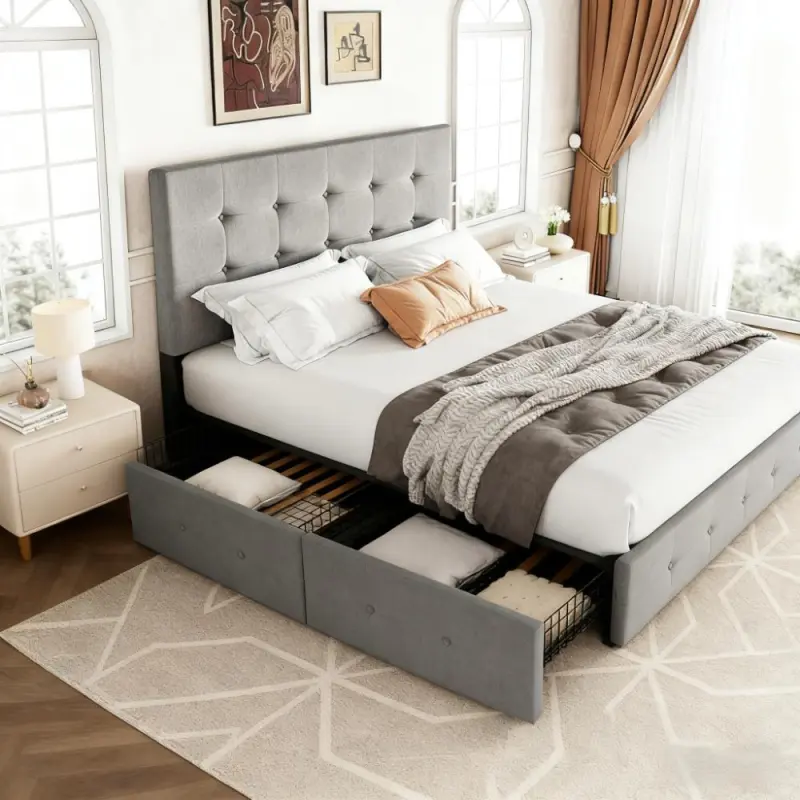
A quiet bedroom environment plays a vital role in ensuring restful sleep and overall comfort. Modern storage beds often incorporate silent sliding rails to enhance user experience by reducing noise during drawer operation. However, how can a typical household user confidently verify the static and dynamic noise levels of these storage bed rails without complex instruments? This guide demystifies the core technologies—such as ball bearing rails, damping systems, and noise-reducing track designs—and offers a practical, easy-to-execute approach: the light push drawer self-test.
Silent rails work by minimizing friction and mechanical noise often produced by traditional metal-on-metal contact within drawers. Here are the three main technical features contributing to effective noise reduction:
Quality assurance in storage bed rails isn’t subjective—it’s substantiated by international standards like EN71 and ASTM F400. These norms outline permissible noise levels, material safety, and mechanical durability to protect consumers:
Manufacturers adhering to these standards typically provide test reports verifying that their rails produce less than 30 decibels of noise under normal closing forces—comparable to a quiet whisper.
Home users can simulate professional noise testing by performing this simple method without any specialized equipment:
A high-quality silent rail will demonstrate an effortless, whisper-quiet glide, with noise levels roughly below 30 decibels, which can be roughly gauged by the lack of audible harsh sounds during the test. If the drawer produces sharp metallic sounds or irregular resistance, the rail may not meet silent performance standards.
Independent testing across three popular storage bed models revealed:
| Model | Rail Type | Measured Noise Level (dB) | User Comfort Rating (1-5) |
|---|---|---|---|
| Model A | Standard Metal Rail | 45 dB | 2.5 |
| Model B | Ball Bearing + Damping Rail | 28 dB | 4.8 |
| Model C | Polymer Noise Reduction Track | 32 dB | 4.2 |
The data underscores how ball bearing rails combined with damping technology deliver superior silent operation and user satisfaction.
For consumers focusing on a silent and smooth drawer experience, consider the following criteria:
Remember, a slightly higher initial investment in top-tier silent rails translates into years of enhanced comfort and fewer noise-related disturbances.
 227
|
227
|
 hydraulic lift bed selection
100
000 cycle durability test
storage bed technical specs
export furniture quality standards
home furniture procurement guide
118
|
L-shaped sofa for small apartments
Corner sofa
Removable cushion sofa
medieval style sofa
Sofas suitable for studio apartments
383
|
modular sofa compliance
EN71 standard
ASTM F400-09
furniture export certification
child safety in furniture
436
|
Modular sofa design
Flat packaging optimization
Pine frame structure
High - density foam filling
Export furniture logistics solutions
447
|
modular sofa
pine wood frame
high-density foam
metal-reinforced MDF
sofa structural stability
hydraulic lift bed selection
100
000 cycle durability test
storage bed technical specs
export furniture quality standards
home furniture procurement guide
118
|
L-shaped sofa for small apartments
Corner sofa
Removable cushion sofa
medieval style sofa
Sofas suitable for studio apartments
383
|
modular sofa compliance
EN71 standard
ASTM F400-09
furniture export certification
child safety in furniture
436
|
Modular sofa design
Flat packaging optimization
Pine frame structure
High - density foam filling
Export furniture logistics solutions
447
|
modular sofa
pine wood frame
high-density foam
metal-reinforced MDF
sofa structural stability